In this paper, we propose TRIPLE, (TPB-dRIven Profiling with LLM rEfinement), a dynamic profiling framework that incorporates the Theory of Planned Behavior (TPB) into user profile modeling. Our method (1) extracts TPB components from historical text data to construct an initial user profile, (2) iteratively refines this profile by analyzing discrepancies between predicted and actual behaviors, and (3) continuously updates the user’s state by incorporating newly arriving text. We evaluate TRIPLE on the LaMP datasets, focusing on rating prediction and personalized tweet paraphrasing tasks, using multiple open-source large language models. Experimental results demonstrate that TRIPLE consistently outperforms existing profiling methods across all evaluation settings. Qualitative analysis confirms that TRIPLE captures the psychological and social mechanisms underlying users' product evaluation and description. These findings provide empirical evidence that theory-driven user profiling can significantly improve personalization performance in recommender systems and related applications.
Accurate user profiling remains a central challenge in personalized services. While behavioral intentions are shaped by personal attitudes, subjective norms, and perceived behavioral control, existing LLM-based profiling approaches often extract only surface-level preferences without systematically modeling the core latent variables that drive user behavior.
To address these limitations, we propose TRIPLE (TPB-dRIven Profiling with LLM rEfinement), a dynamic profiling framework that incorporates the Theory of Planned Behavior (TPB) into user modeling. TRIPLE leverages LLM reasoning to extract key TPB components—attitude, subjective norms, and perceived behavioral control—from input data and represent them in natural language. These latent variables are then continuously updated through a prediction-evaluation-refinement cycle to better reflect evolving user states.
This work presents the first systematic integration of social-psychological theory into LLM-based profiling, offering broad applicability across various LLMs without the need for additional training. TRIPLE demonstrates strong potential for application across diverse domains, offering insights to guide future research.
We evaluate TRIPLE on the LaMP benchmark, focusing on two representative tasks:
To preserve the temporal structure of user behavior, we use a time-based separation approach for evaluation on the test set.
TRIPLE's refinement cycle continuously adapts user profiles through behavioral feedback. When behavior predictions deviate from actual outcomes, the framework analyzes the error and updates the TPB components to better capture the user's psychological state.
Below is a real example showing how a user's TPB profile evolves through the refinement process across multiple product reviews. Each refinement iteration updates the profile based on behavioral discrepancies to capture evolving user preferences.
Review: "Very comfortable, and warm. Excellent sale, and a fast shipment and receipt."
New Review: "Had to return two pair, because the manufactures shoe last is 1 to 1/2 size smaller than any other foot wear I have, Of the same size."
Latest Review: "The sale was easy, and shipping was fine. These are a very comfortable boot, with apparent strong materials and sewing. While the above is true...so is the fact the Boot sold as water proof LEAKS HORRIBLY Leaving feet soaked from wet grass!"
This example demonstrates how TRIPLE captures the evolution of user attitudes and behavioral patterns over time. The framework adapts to new experiences (sizing issues, quality problems) while maintaining core user preferences (comfort, reliability), enabling more accurate personalization as more behavioral data becomes available.
Below are examples of user profiles generated by TRIPLE, showing how the framework extracts and structures the three key components of the Theory of Planned Behavior from user behavioral data.
User Context: A user who frequently purchases and reviews electronics products
Generated TPB Profile:
This example demonstrates how TRIPLE captures not just surface-level preferences, but the underlying psychological and social factors that drive user behavior, enabling more accurate and interpretable personalization.
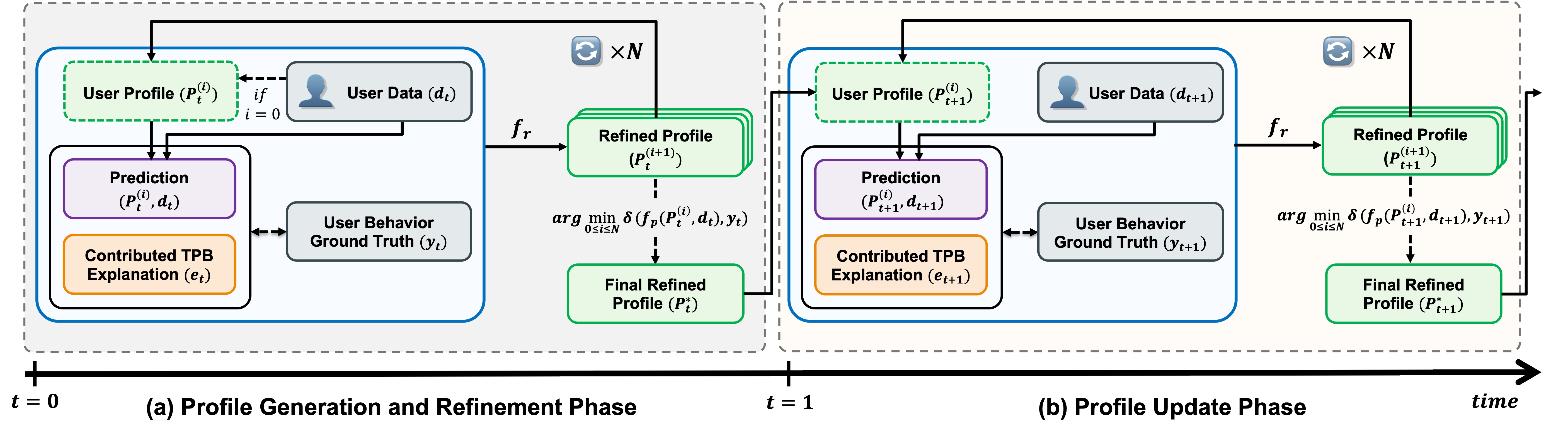
The TRIPLE framework consists of four main stages: (1) generating an initial profile by extracting TPB components using an LLM, (2) performing a personalization task using the generated profile, (3) refining the profile based on behavior prediction results, and (4) dynamically updating the user profile over time. The overall architecture is illustrated in the figure at the top of the page.
1. TPB-based Initial Profile Construction: We analyze a user's textual data using an LLM to extract the three key components of the Theory of Planned Behavior (TPB): attitude, subjective norm, and perceived behavioral control. These are stored in a structured JSON format.
2. Profile Refinement: We adopt an iterative cycle of prediction, evaluation, and refinement. Given a profile, the model predicts user behavior. The prediction is compared with the ground truth, and the resulting error is used to prompt the LLM to refine the profile. This is repeated N times (N=5 in our experiments) to select the best-performing profile.
3. Profile Update: To capture temporal changes, the optimal profile from the previous time step is used as the starting point for refinement with new user data. This allows the model to progressively adapt to the user's evolving preferences and behavioral patterns over time.
To ensure reproducibility and transparency, we provide the key prompts used in our TRIPLE framework. These prompts guide the LLM through the TPB-based profiling process.
You are highly skilled at role-playing. Imagine that you are a top-tier user-profiling expert.
Your goal is to:
- generate a Theory of Planned Behavior (TPB)–based profile of the user.

# General Task Description
The user's past data is provided. This past data consists of reviews the user previously wrote about a specific product.
- Past data [review]: {history}

# Task Instructions
Your task is to take the [review] as input and create a TPB-based profile of the user.
- The Theory of Planned Behavior is designed to explain and predict human behavior.
- The user's profile must be composed of the main TPB components. Read each component's definition carefully and populate it with information drawn from the user's past data.
- Please write the profile solely with "Attitude", "Subjective norm", "Perceived Behavioral Control" presented in narrative form.

# Profile components:
- Attitude
    - Definition: The user's positive or negative evaluation of performing the specific behavior.
- Subjective norm
    - Definition: The social pressure the user perceives to perform or not perform the behavior.
- Perceived Behavioral Control
    - Definition: The user's perception of how easy or difficult it is to perform the behavior, reflecting past experience as well as anticipated

First, you must develop your reasoning according to [Profiler Thought]. Follow the step-by-step guide below, and write your response in JSON format using the specified field names.

# Profiler Thought
1. Understand what information is contained in [review].
2. Identify which parts of [review] map to the TPB profile components.
3. Write the profile. Do not change the names of the profile components.
4. Each component must not exceed two sentences.

# Output Format
Respond in the following JSON format:
{{
  "attitude": "...",
  "subjective_norm": "...",
  "perceived_behavioral_control": "..."
}}

Start the profiling
Begin the profiling task now! Strictly follow [Task Instructions] and output your response in JSON format. You are highly skilled at role-playing. Imagine you are an expert rating predictor.
Your goal:
- Predict a rating between 1.0 – 5.0 based on the user profile and review content.
# General Task Description
You are given:
- A user profile based on the Theory of Planned Behavior [profile]: {profile}
- A specific user review [review]: {review}
# Task Instructions
Using the given [profile], understand the user and predict the rating they would give to the [review]. First, structure your thinking according to the [Predictor Thought] steps below. Follow the steps carefully and respond in JSON format using the exact field names provided.
# Predictor Thought
1. Profile Analysis: Understand the provided [profile].
2. Component Relationship Analysis: According to TPB theory, determine the user’s intention—the degree to which they decide to perform a behavior—by considering the combination of Attitude, Subjective Norm, and Perceived Behavioral Control.
3. Review Analysis: Understand the review written by the user.
4. Prediction: Integrate insights from the profile and review to predict the most likely integer rating between 1–5.
5. Explanation: Clearly state the reasoning for your prediction in the [explanation] field.
# Output Format
Respond in the following JSON format:
{{
"explanation": "...",
"rating": "..."
}}
# Start the Prediction
Begin the rating prediction task now! Strictly follow the [Task Instructions] and respond in the specified JSON format.You are highly skilled at role-playing. Imagine that you are a top-tier refinement expert.
Your goal is to:
- Refinement the user's TPB-based profile.
# General Task Description
The user's past data is provided. This past data consists of reviews the user previously wrote about a specific product.
- Past data [review]: {history}
- Rating attached to the review [ground truth]: {gt}
- User's Theory of Planned Behavior-based profile [profile]: {profile}
- Predicted rating based on the profile [prediction]: {pred}
- Basis for the predicted rating [explanation]: {explanation}
# Task Instructions
Your task is to refine the TPB-based [profile] to reduce the discrepancy between [prediction] and [ground truth] based on the grounds provided in [explanation].
First, you must develop your thinking as specified in [Refiner Thought]. Follow the step-by-step guide below, and write your response in JSON format using the specified field names.
# Refiner Thought
1. Understand how the prediction deviated from the ground truth by comparing [prediction] and [ground truth].
2. Identify which aspects of the [profile] might have contributed to this discrepancy based on [explanation].
3. Decide on the direction of refinement.
- [prediction] > [ground truth]:
- The user's attitude may have been overestimated, so soften positive expressions or incorporate more negative/neutral cues.
- Check whether social pressure (Subjective Norm) or perceived behavioral control (PBC) has been described higher than in reality, and modestly adjust them if necessary.
- [prediction] < [ground truth]:
- The user's attitude may have been underestimated, so emphasize positive experiences and satisfaction factors.
- Strengthen the surrounding positive influence (Subjective Norm) or the perceived control (PBC) derived from successful experiences, adding grounds for the user to give a higher rating.
4. Do not include exact numeric values ([ground truth]) in the refined [profile].
5. Each component of the refined [profile] must not exceed two sentences.
# Output Format
Respond in the following JSON format:
{{
"attitude": "...",
"subjective_norm": "...",
"perceived_behavioral_control": "..."
}}
# Start the Refinement
Now begin your Refinement task! You should format your response strictly following the [Task Instructions]. Output the result in JSON format. These prompts are designed to systematically guide the LLM through each stage of the TRIPLE framework, ensuring consistent extraction and refinement of TPB-based user profiles across different tasks and domains.
We employed 4 NVIDIA A100 GPUs for testing. The temperature was set to 0 for both tasks. The maximum token length was set to 1000 to accommodate comprehensive TPB component descriptions while maintaining computational efficiency. We performed up to 5 refinement iterations. All baselines were re-implemented using prompts provided in their original papers or official GitHub repositories. The entire experimental pipeline was implemented in Python and will be released upon publication.
@inproceedings{noh2025triple,
  author    = {Noh, Taehyung and Jin, Seungwan and Yeo, Haein and Han, Kyungsik},
  title     = {Externalizing Social-Cognitive Structures for User Modeling: Toward Theory-Driven Profiling with LLMs},
  booktitle = {Proceedings of the 34th ACM International Conference on Information and Knowledge Management (CIKM '25)},
  year      = {2025},
  month     = {November},
  publisher = {ACM},
  doi       = {10.1145/XXXXXX.XXXXXX},
}