A Study on User Perception and Experience Differences in Recommendation Results by Domain Expertise: The Case of Fashion Domains

Taehyung Noh1, Haein Yeo1, Myungjin Kim1, Kyungsik Han1,
1Hanyang University

Abstract

Recommender systems widely support user decision-making, yet users differ in how they understand and evaluate algorithmic results. This study investigates how domain expertise—specifically fashion knowledge and interest—shapes user perception and satisfaction with fashion-recommendation outcomes. We built My Own Style (MOS), a dashboard that analyzes a given outfit image and recommends similar/diverse fashion items using three algorithms with different similarity–diversity characteristics. A large-scale study with 166 participants shows that fashion experts better understand algorithmic outputs and prefer highly similar recommendations, whereas non-experts prefer more diverse results. These findings provide empirical implications for designing personalized RS experiences based on domain expertise.

Overview

Research Questions

This study addresses two key research questions: First, do domain experts perceive and understand recommendation results differently? Second, do domain experts prefer different types of recommendation results? These questions guide our investigation into how fashion expertise influences user interaction with recommender systems.

Key Idea

User satisfaction and interpretation of recommender system outputs vary by domain knowledge. Thus, instead of a single one-size-fits-all recommender, RS should adapt the similarity–diversity balance depending on who the user is (expert vs. general user). This personalized approach can enhance both user understanding and satisfaction with recommendation results.

System: My Own Style (MOS)

MOS is a dashboard that recommends outfits for an input fashion image using three tailored algorithms.

Dataset

Our system leverages a comprehensive dataset of 699,613 fashion images, including 401,825 runway images from 2010–2022, 48,533 public fashion images, and 249,255 street fashion photographs. This diverse collection enables robust recommendations across various fashion contexts and styles.

Algorithms

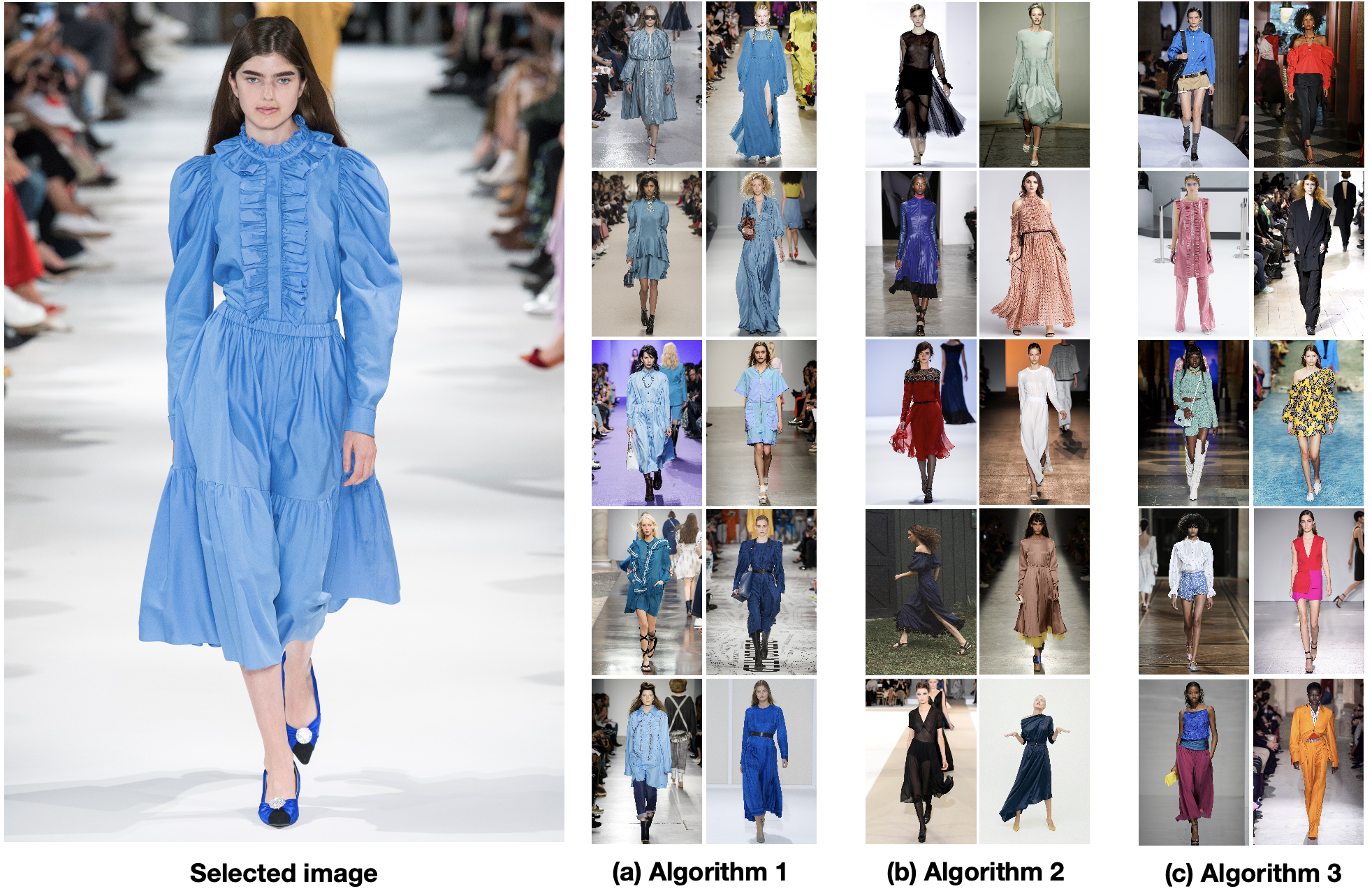
MOS implements three distinct recommendation algorithms with varying similarity-diversity characteristics: Image Feature-Based Recommendation (high similarity), Fashion Element-Based Recommendation (mid similarity & diversity), and Random-Based Recommendation (high diversity). This multi-algorithm approach allows us to systematically investigate user preferences across the similarity-diversity spectrum.

Interface

Users can search for fashion items through multiple filters including year, season, color, and fashion elements. Upon selecting an image, the system displays a detailed element breakdown alongside top-10 recommendations from each algorithm presented side-by-side, enabling direct comparison of different recommendation strategies.
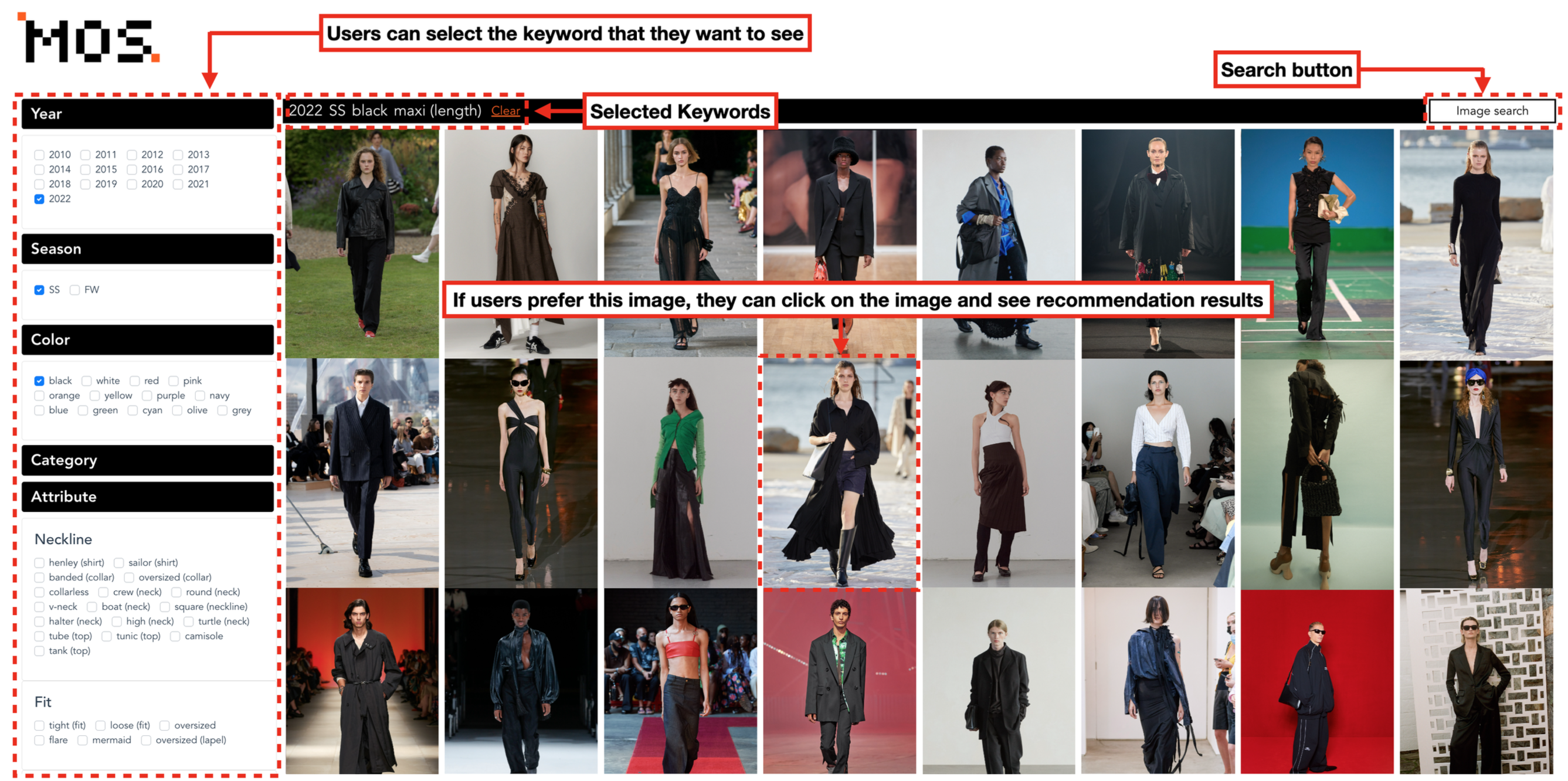
My Own Style (MOS) Interface

User Study

We conducted a large-scale user study at a design festival booth to investigate how domain expertise affects the perception and preference of recommendation results.

Participants

We recruited 166 participants from a design festival booth, comprising 35 fashion experts, 59 designers, and 72 members of the general public. This diverse sample enabled us to examine how fashion expertise influences recommendation perception and preferences. Participants were grouped based on their Fashion Characteristics (FC), which we measured through self-reported ratings of interest in fashion, knowledge of fashion, and perceived expertise. Based on these measures, we classified participants into a High FC group (100 participants) representing fashion-knowledgeable users, and a Low FC group (66 participants) representing general users with limited fashion expertise.

Procedure

The study consisted of two main components. First, participants completed the Fashion Characteristics (FC) measure, rating their interest in fashion, knowledge of fashion, and perceived expertise on structured scales. This assessment allowed us to classify participants into expertise groups. Second, participants engaged in evaluation tasks using the MOS system. For each task, they were presented with recommendation results from all three algorithms and asked to identify which algorithm produced the most similar recommendations, which produced the most diverse recommendations, and which recommendation set they preferred overall (i.e., found most satisfying). This dual-task design enabled us to separately assess both understanding (similarity/diversity perception) and preference (satisfaction) across expertise levels.

Results

RQ1 – Understanding of Recommendations

Similarity Perception

Our findings reveal significant differences in how users perceive similarity-based recommendations. Participants with High FC (Fashion Characteristics) correctly identified Algorithm 1 (high similarity) 78% of the time, whereas those with Low FC achieved only 64% accuracy. This indicates that experts understand similarity-based results significantly better than non-experts, suggesting that domain knowledge enhances the ability to recognize nuanced visual similarities in fashion items.

Diversity Perception

In contrast to similarity perception, we found no significant difference between groups in identifying diverse recommendations. This suggests that diversity is easier for all users to recognize, regardless of their fashion expertise. The cognitive process of detecting dissimilarity appears to be more universal and less dependent on domain-specific knowledge.

RQ2 – Preference for Recommendation Results

High FC (Experts) Prefer Similar Recommendations

Fashion experts demonstrated a strong preference for similarity-driven recommendations, with 71% preferring Algorithm 1 and only 29% favoring diverse results (Algorithms 2 & 3). This preference pattern suggests that experts value the precision and visual coherence that similarity-based recommendations provide, likely because they can better appreciate the subtle stylistic alignments in such results.

Low FC (Non-Experts) Prefer Diverse Recommendations

Non-experts showed a different preference pattern, with 52% preferring diversity-driven algorithms (Algorithms 2 & 3) compared to 48% preferring similarity-based results. This near-even split, tilting slightly toward diversity, indicates that novice users value exploration and variety over precision, possibly because diverse recommendations help them discover new styles and broaden their fashion horizons.

Interpretation

These findings reveal a fundamental divide in how different user groups interact with fashion recommender systems. Experts value precision and visual coherence, seeking recommendations that closely match their refined aesthetic sensibilities. In contrast, novices value diversity and exploration, preferring systems that expose them to a broader range of options. This suggests that effective fashion RS should adapt their similarity-diversity balance based on user expertise levels to maximize satisfaction and engagement.

Recommendation Examples

The following examples demonstrate how our three algorithms generate different recommendation results for the same input image, showcasing the spectrum from high similarity to high diversity.

Recommendation Examples

Left to Right: Image Feature-Based (High Similarity) | Fashion Element-Based (Mid Similarity & Diversity) | Random-Based (High Diversity)

Key Contributions

This research makes several important contributions to the field of recommender systems and human-computer interaction. We provide empirical evidence that domain expertise significantly influences both perception and preference of recommendation results, particularly in the fashion domain. Our study demonstrates that experts better understand similarity-based recommendations and prefer them over diverse results, while novices show the opposite pattern. Additionally, we introduce My Own Style (MOS), a comprehensive fashion recommendation dashboard that implements three distinct algorithms spanning the similarity-diversity spectrum, enabling systematic investigation of user preferences. Finally, our findings offer practical design implications for personalized recommender systems that adapt to user expertise levels, suggesting that one-size-fits-all approaches may be suboptimal for diverse user populations.

BibTeX

@inproceedings{noh2023study,
  title={A study on user perception and experience differences in recommendation results by domain expertise: the case of fashion domains},
  author={Noh, Taehyung and Yeo, Haein and Kim, Myungjin and Han, Kyungsik},
  booktitle={Extended abstracts of the 2023 CHI conference on human factors in computing systems},
  pages={1--7},
  year={2023}
}