Abstract
While large language model (LLM)-based user profiling offers significant potential for personalization, most existing approaches rely on empirical heuristics and lack grounding in the psychological mechanisms that drive human behavior. We introduce TRIPLE (Theory-guided Reasoning for Intent and habIt Profiling with LLMs for pErsonalization), a novel framework that systematically integrates dual-process theory from social psychology into LLM-based user modeling. TRIPLE (1) constructs a habitual behavior profile by identifying repeated patterns over time to model automatic responses; (2) builds an intentional behavior profile by inferring user attitudes, subjective norms and perceived behavioral control based on the Theory of Planned Behavior (TPB); and (3) generates behavioral rationale that reveal the interaction between habitual and intentional processes to predict user behavior in context-specific situations. We evaluate TRIPLE on five personalization tasks from the LaMP benchmark using multiple open-source LLMs. Results show that TRIPLE consistently outperforms existing in-context learning methods, with especially pronounced gains on complex generative tasks such as headline and title generation. Qualitative analyses further demonstrate that the profiles and reasoning paths generated by TRIPLE provide interpretable and psychologically grounded explanations of user behavior.
Framework Overview
TRIPLE integrates Dual-Process Theory into LLM-based personalization by modeling user behavior through two complementary cognitive systems: habitual processes (automatic, shaped by repeated experiences) and intentional processes (driven by conscious deliberation). This theory-driven approach enables TRIPLE to capture not only what users do, but also why they do it.
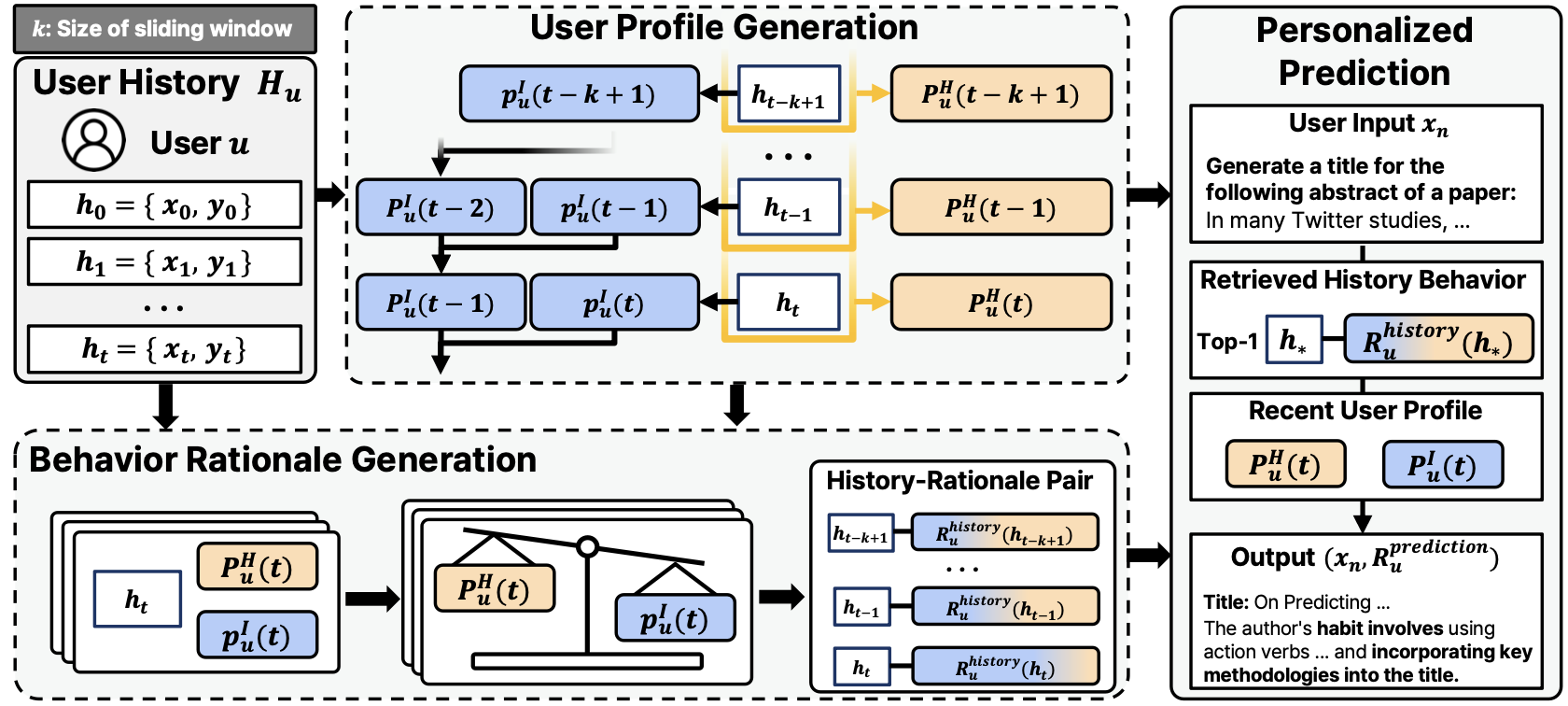
Figure 2: TRIPLE Framework Architecture
Core Components
Habitual Behavior Profile
Captures automatic, routine behaviors by identifying repeated behavioral patterns from user history. Uses a sliding window approach to extract situational cues and their consistent responses, modeling unconscious tendencies that arise from long-term experience.
Intentional Behavior Profile
Models goal-directed, deliberate actions based on the Theory of Planned Behavior (TPB). Infers three key components: Attitude (evaluations), Subjective Norm (social pressure), and Perceived Behavioral Control (perceived capability). Updated incrementally as new behaviors occur.
Behavioral Rationale
Synthesizes both profiles to generate interpretable explanations of user behavior. Through a 4-step reasoning process (habit-based prediction → intention-based review → self-verification → integrated reasoning), the rationale identifies which cognitive process dominates in specific contexts and explains how habitual and intentional factors interact.
Main Results
We evaluated TRIPLE on five personalization tasks from the LaMP benchmark: news categorization (LaMP-2N), movie tagging (LaMP-2M), product rating (LaMP-3), news headline generation (LaMP-4), and scholarly title generation (LaMP-5). Experiments were conducted using three LLaMA models (3.1-70B, 3.1-8B, 3.2-3B).
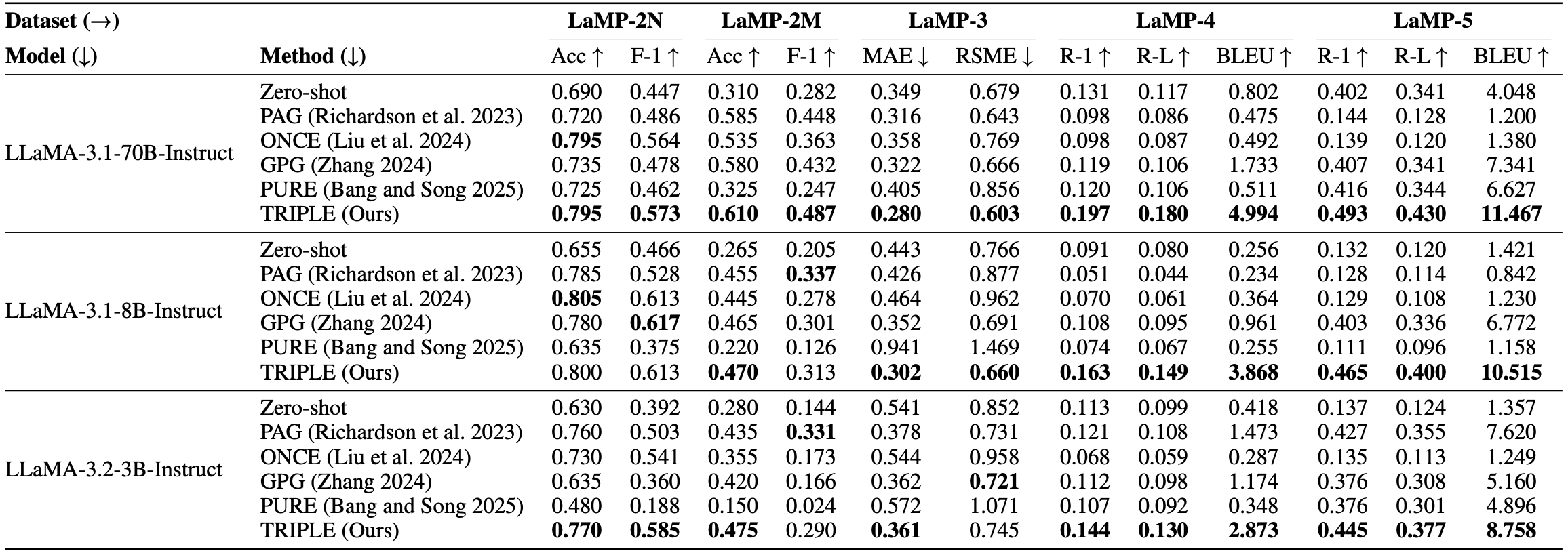
Table 2: Performance Comparison on LaMP Benchmark
Key Findings
- Superior Performance on Generative Tasks: TRIPLE achieves state-of-the-art results on LaMP-4 (news headline generation) and LaMP-5 (scholarly title generation), significantly outperforming baselines (PAG, ONCE, GPG, PURE) across all metrics (ROUGE-1, ROUGE-L, BLEU). For example, on LaMP-5 with LLaMA-3.1-70B, TRIPLE achieves 11.467 BLEU compared to 7.341 for the next-best baseline.
- Behavioral Rationale is Critical: Ablation studies show that combining both profiles without the behavioral rationale can hurt performance, as the two profiles may provide conflicting signals. The rationale acts as a reasoning scaffold that reconciles habitual and intentional processes, leading to consistent gains across tasks.
- Scalability with User History: TRIPLE demonstrates excellent scalability—performance improves steadily as more user history (k) becomes available, particularly on generation tasks. In contrast, baseline methods plateau beyond k=4, suggesting limited ability to extract deeper insights from larger behavioral windows.
Profile Example
Below is an example from LaMP-5 (scholarly title generation) showing how TRIPLE models a user's habitual writing patterns, intentional factors (TPB), and how these processes interact when generating a title. This example demonstrates TRIPLE's ability to explain behavioral conflicts—where habitual tendencies (starting with action verbs) are overridden by intentional goals (conforming to academic conventions).
Figure 4: LaMP-5 Profile Example
Showing Habitual Profile, Intentional Profile, and
Behavioral Rationale
(Placeholder - Image to be added)
Example Behavioral Rationale
"The researcher chose the title 'On Predicting Geolocation of Tweets using Convolutional Neural Networks' due to a combination of habitual and deliberate cognitive processes. Their habitual writing patterns influenced the use of action verbs, but the TPB factors—particularly the subjective norm and perceived behavioral control—led to a more concise and formal title that prioritizes clarity and accuracy. The TPB factors overrode the habitual response to create a title that meets established academic standards and expectations. The final title reflects a balance between creativity and informativeness, aligning with the researcher's values and goals."
This interpretable, psychologically-grounded explanation demonstrates TRIPLE's unique capability to reveal the cognitive mechanisms underlying user decisions—going beyond simple pattern matching to explain why users behave the way they do.